
Refillable beverage containers are a key component of the circular economy. Unlike single-use containers, they are designed to be reused multiple times, helping to prevent waste at source and promote more efficient use of resources.
In a refillable beverage system, consumers purchase a drink in a container for which a refundable deposit is charged. Once the beverage has been consumed, the empty container is returned to the retailer or an authorised collection point. The deposit is then refunded to the consumer. Returned containers are collected by the supplier, cleaned and sanitised according to established standards, and refilled for redistribution.
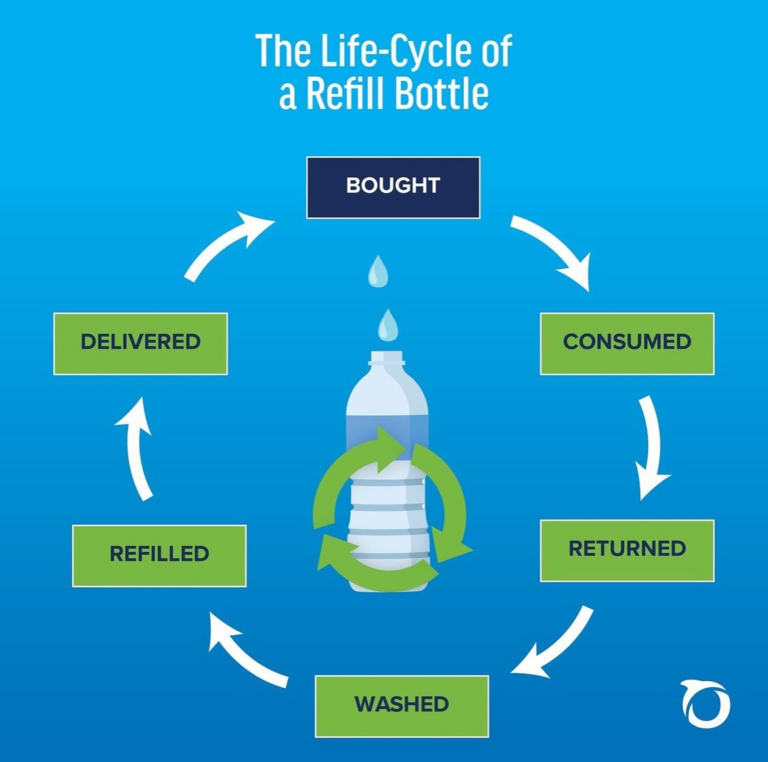
By extending the lifespan of beverage containers, refillable systems significantly reduce the demand for new packaging materials. This contributes to lower energy and water consumption, reduced greenhouse gas emissions, and less waste sent to landfill or incineration. Refillable beverage containers, therefore, play a key role in preventing waste and supporting sustainable production and consumption patterns.
Beyond environmental benefits, refillable systems encourage responsible consumer behaviour by making waste prevention part of everyday purchasing decisions.
The use of refillable beverage containers demonstrates how circular economy principles can be applied in practice: keeping materials in use for as long as possible, reducing reliance on single-use packaging, and minimising environmental impact. By supporting refillable systems, consumers, businesses, and institutions contribute to a more resource-efficient and sustainable economy.
Certain beverage products packaged in refillable containers—such as water, soft drinks and mixers—may be exempt from the Beverage Container Refund Scheme (BCRS), subject to approval by Circular Economy Malta (CEMalta).
These exemptions are granted under the First Schedule of the Beverage Containers Recycling Regulations, 2020 (S.L. 549.134), specifically Article 19 – Exemption from the Scheme for refillable containers. Exempted products do not fall under the BCRS and instead operate under a Producer Deposit Return System.
Producers wishing to apply for an exemption under Article 19 of S.L. 549.134 are invited to contact the Agency at [email protected]
In line with the obligations arising under Subsidiary Legislation 549.134, producers placing refillable beverage containers on the market are required to adhere to specific reporting and compliance measures, notwithstanding their exemption from the Beverage Container Refund Scheme (BCRS).
As stipulated under Regulation 22 of S.L. 549.134, producers must submit detailed quarterly reports to Circular Economy Malta (CEMalta). These reports must include:
Regulation 22 further specifies that:
“Such information shall be filed with the Agency on a quarterly basis, and in any case not later than fifteen (15) days from the end of each quarter.”
These reports ensure that producers remain compliant with the statutory oversight of refillable systems and enable monitoring of progress against legally binding collection targets.
Pursuant to Regulation 22, and for the purpose of preparing the annual report referred to in Regulation 36, producers must also provide CEMalta with all necessary financial and operational information relating to their refillable container systems. This includes:
This obligation ensures transparency and accountability in how refillable systems operate, particularly regarding consumer deposits and the financial sustainability of the system.
Producers of refillable beverage containers must therefore comply with both operational reporting (quarterly submissions on quantities placed and collected) and financial reporting obligations (system financial position and deposit account status), in line with S.L. 549.134. These duties apply irrespective of exemption from the BCRS, ensuring that producers remain accountable for meeting the annual collection targets laid down in the legislation—ranging from 70% in 2022 and 2023 to 90% from 2026 onwards (kindly refer to the Table below).
| Period | Target (% by weight of refillable containers placed on the market) |
|---|---|
|
1 Jan 2022 – 31 Dec 2022 |
70% |
|
1 Jan 2023 – 31 Dec 2023 |
70% |
|
1 Jan 2024 – 31 Dec 2024 |
80% |
|
1 Jan 2025 – 31 Dec 2025 |
85% |
|
1 Jan 2026 – 31 Dec 2026 and thereafter |
90% |
When purchasing a beverage in an exempted refillable container, in a Business-to-Consumer model:

